Pull out your driver’s license right now and look at the top-right corner. That single glance will tell you everything you need to know before your next domestic flight.
Since May 7, 2025, the TSA has been turning away travelers whose state-issued licenses don’t meet the REAL ID standard. No star marking, no boarding — unless you have a passport on you or are willing to pay a $45 fee at the checkpoint. Millions of Americans are still carrying the wrong card without knowing it.
New driver’s licenses: What the marking actually looks like
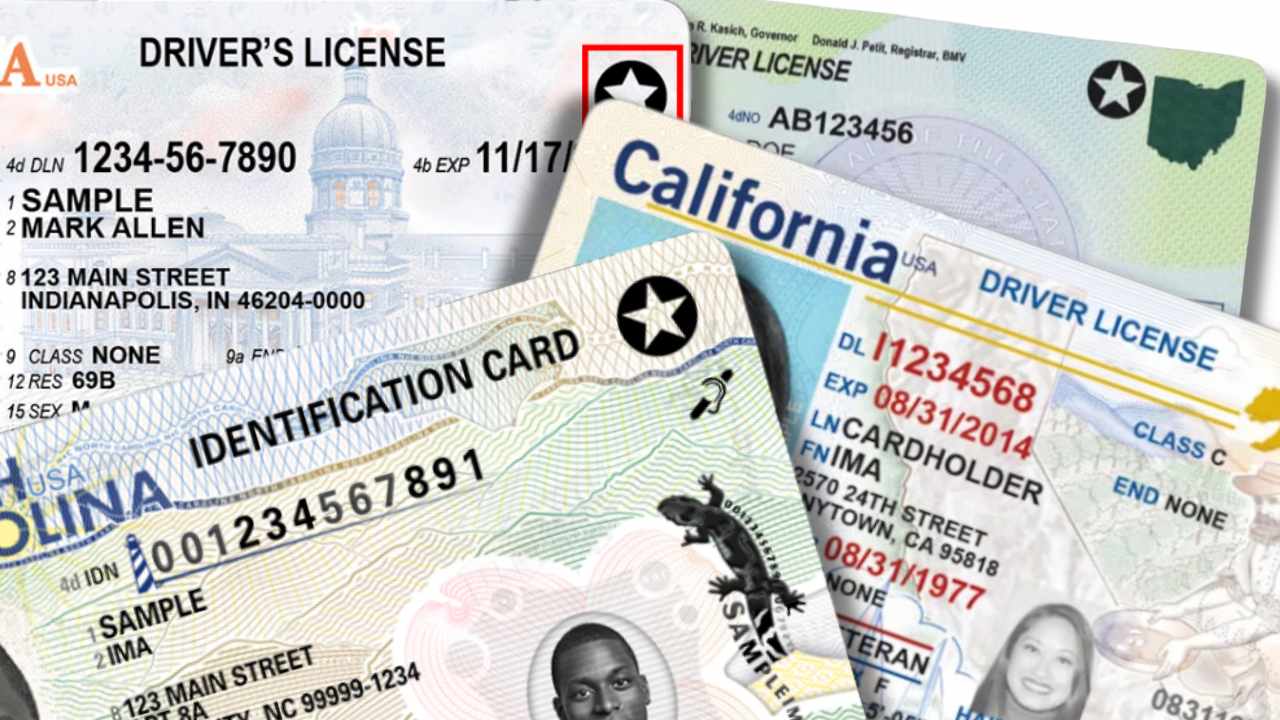
A gold star in the upper-right corner is the clearest sign your license is compliant. But states have gotten creative with the design. California puts a grizzly bear next to the star. Texas has used a circle with an inset star since October 2016. Michigan has two valid versions in circulation: the older design has a star in a gold circle, and the newer one places a star over the state’s outline. Both work.
If your license reads “NOT FOR FEDERAL IDENTIFICATION,” “FEDERAL LIMITS APPLY,” or anything close to that, you are not compliant. Cards issued before 2024 with no marking at all almost certainly fall into the same category. A federal regulation that took effect February 21, 2024 now requires all newly issued non-compliant licenses to state “NOT FOR REAL ID ACT PURPOSES” — so newer cards at least tell you plainly where they stand.
The flag is also fine
Five states — Washington, Michigan, Minnesota, New York, and Vermont — issue what is called an Enhanced Driver’s License. These carry a U.S. flag symbol rather than a star. They are fully accepted at TSA checkpoints and also work at land and sea border crossings with Canada, Mexico, and the Caribbean, something a standard REAL ID cannot do. If yours has the flag, you are covered.
Now, your state being “compliant” does not mean your license is. Every single state, plus D.C. and the five U.S. territories, has met the federal standards required to issue REAL ID cards. That part is settled. What is not settled is whether the license sitting in your wallet was actually issued under those standards.
REAL ID has always been opt-in. When you applied or renewed, you either brought the required documents — a certified birth certificate or passport, your Social Security card or a document showing your number, and two proofs of state residency — or you did not. If you came up short on paperwork, if you chose the standard option, or if your license predates your state’s compliance rollout, the star is not on your card.
Your three paths forward
If your license does not have the star, you have options, none of them particularly painful. The simplest is already in your drawer: a valid U.S. passport or passport card works at every TSA checkpoint, full stop. So does a Global Entry card or any other DHS Trusted Traveler credential.
If you want the star on your license, head to your state DMV with the documents mentioned above. The visit is one-time. Once your file is verified and the star is added, every future renewal carries it forward automatically — you will never have to prove your identity from scratch again.
The third option is newer. Starting February 1, 2026, the TSA began offering a program called TSA ConfirmID. For $45 paid online before you travel, the agency attempts to verify your identity through other federal databases. The clearance lasts ten days from your departure date. It works, but it was designed as a temporary bridge — not a replacement for getting your documents in order.
How enforcement actually works right now
The hard deadline was May 7, 2025. Full stop. However, DHS published a rule in January 2025 allowing certain federal agencies — not necessarily the TSA — to phase in enforcement over up to two years, meaning some may still issue warnings rather than outright denials through May 2027. The TSA has made no such public commitment for airports. Counting on leniency at the checkpoint is a gamble most travelers should not take.
Part of why the flexibility exists at all: DHS estimated that only about 61 percent of licenses in circulation were REAL ID compliant when enforcement started. Tens of millions of people were still carrying the wrong card. That number is improving as states process renewals, but the backlog at some DMV offices reflects exactly how many people waited until the deadline arrived.
A non-compliant license still lets you drive, vote, and handle most everyday business. What it no longer does is get you on a plane.